Questions
Frequently asked
Everything people ask before they buy a spot, answered plainly.
What is Brand My Tee?
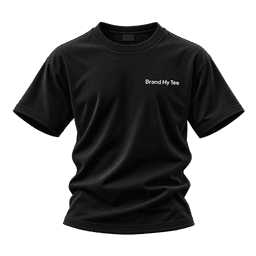
- It is advertising space on a t-shirt. Every month two shirts are printed — one white, one black — each carrying 6 print positions. You buy a position, your logo goes on the cloth, and the shirt is worn in public for the whole month. At the end of the month a results page records where it went and what it cost.
How much does it cost to advertise on a t-shirt here?
- A sleeve or hem position is $129. A chest position is $249. That is the price for the whole drop, and it is the same figure for the first sponsor and the last — there is no auction and no price ladder that climbs as spots sell. October 2026 is the exception, downward: the first drop sells 15% under the list, so a sleeve is $110 and a chest $212 until it closes.
Can one company take a whole shirt?
- Yes. An exclusive reserves an entire tee for one brand at $1,250: your logo prints on the left chest and the lower back, every other position stays blank, and you can print in your own colours rather than the garment's single ink. It costs more than the $1,014 the same shirt raises when its six positions sell separately, because it takes all six off the board and no other brand can appear beside you. There is one per garment per drop.
Are there discounts?
- Two, and neither needs haggling. The first drop sells 15% under the list on every position and either shirt — a chest is $212 instead of $249, a sleeve $110 instead of $129. Then taking the same spot on both tees in one order takes another 10% off the two together, which makes a chest pair $382. The first is on this drop only; the second is there in every drop, because both prints come off one gang sheet.
Why is the first drop cheaper?
- Because there is nothing to check yet. No shirt has been printed, no month has been walked, and there is no results page to read before you decide — every argument on this site is a promise until a drop has been worn. Buying into October 2026 means carrying that, and 15% is what it is worth. From the second drop on, the list price is the price.
Does the price go up?
- Only back to the list when this drop closes. Within a drop every position is one fixed price for the first sponsor and the last — there is no auction, no ladder that climbs as spots sell, and no rate that keeps rising month after month. What runs out is the cloth.
What artwork do you need from me?
- A logo file and, if you want one, a URL. You place the artwork on the shirt yourself during checkout, so what you see on the preview is what gets printed. Every sponsor is approved by hand before the run goes to print, so if a file will not reproduce well you hear about it before anything is printed.
Will my logo be printed in colour?
- Normally no — the shirt is printed in one ink, because six logos in six different colours reads as a bulletin board rather than as clothing. The exception is an exclusive: one brand alone on a garment has no second colour to argue with, so it prints in its own.
How do I know the shirt was actually worn?
- Each drop gets a permanent results page listing the outings, the photographs taken on them, and the public view counts of anything posted. There are no impression estimates and no CPM figures, because there is no honest way to produce them for a t-shirt. You get what actually happened.
Who sees the shirt?
- Whoever is in the room. It is worn to work, to events, to meetups and on camera. That is a small and specific audience rather than a large anonymous one, which is the point — a logo read across a table is worth more attention than an impression counted in a feed.
What happens when a drop sells out?
- The board closes and the run goes to print. Nothing reopens: a sold drop is a printed shirt, and the sponsors on it keep those positions for the whole month. The next month is already on sale — at the list price, since the founding discount belongs to the first drop.
Can you print shirts for my event?
- Small runs for events are taken case by case. Use the enquiry form on the site and describe the run — how many shirts, what date, what needs printing — and you get a reply personally.